
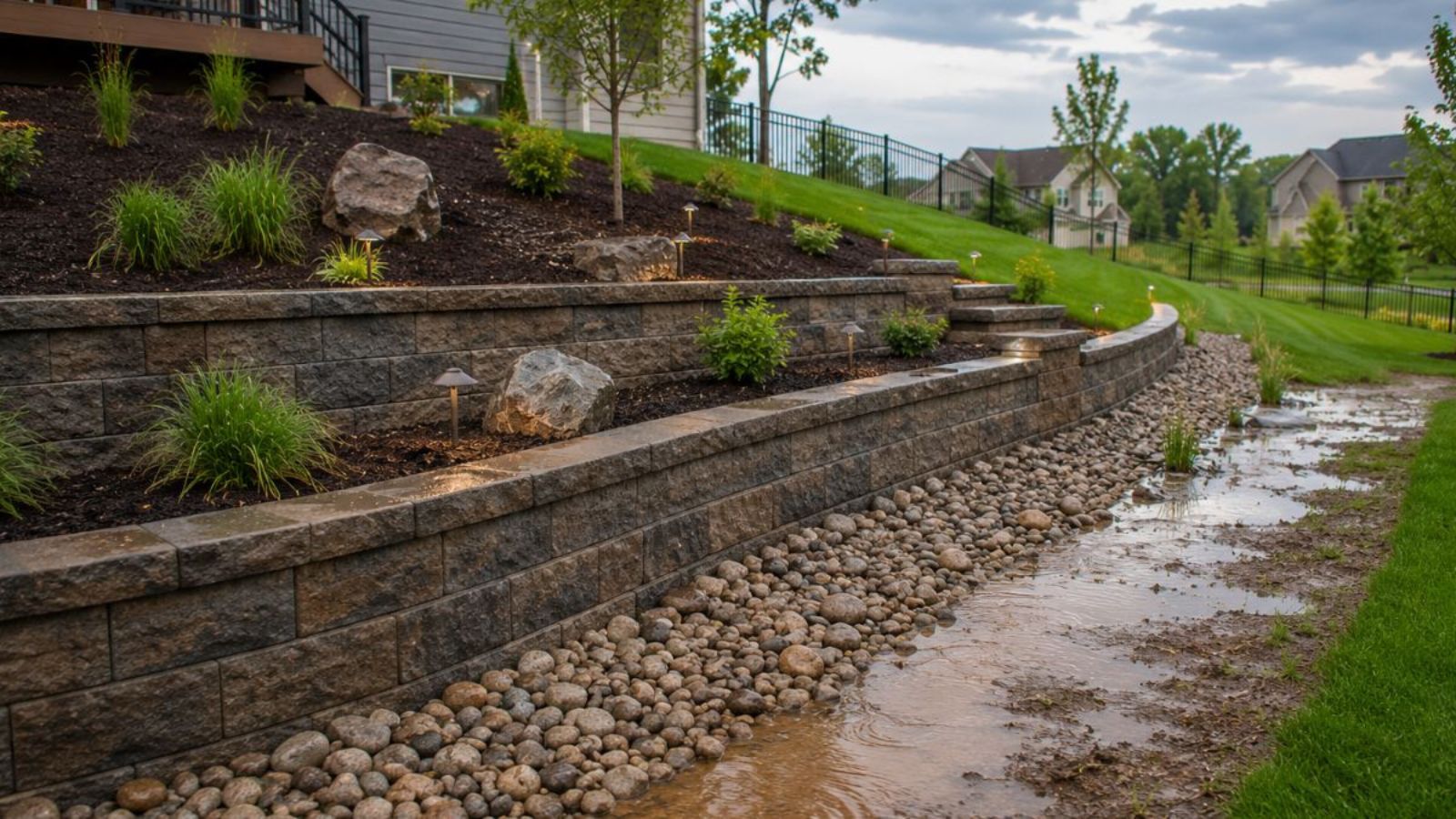
Heavy rain can expose drainage issues that may not be obvious during drier periods. In Elkhorn, homeowners often notice standing water, washed-out mulch, or areas of the yard that remain saturated long after a storm. In many cases, retaining walls and grading are considered when these problems begin affecting the usability and condition of the landscape.
Flooding and erosion rarely improve on their own. Identifying how water moves across a property can help determine what steps may be needed to reduce runoff, stabilize soil, and prevent recurring damage.
Why Flooding Problems Often Appear Years After Construction
Many homeowners assume drainage problems would show up shortly after a house is built. In reality, some of the most common flooding complaints appear several years later.
A situation that comes up frequently in Elkhorn neighborhoods is a yard that drained well for years before changes in the landscape altered the flow of water.
Common factors include:
- New planting beds
- Decorative berms
- Patio expansions
- Added fencing
- Soil settlement over time
- Changes made to neighboring lots
Another challenge is that drainage patterns often evolve as an entire neighborhood matures. New outdoor features installed on surrounding properties can influence where runoff ultimately travels.
Because these changes happen gradually, homeowners are often surprised when a problem suddenly becomes obvious after a particularly heavy rain.
Signs the Real Issue May Be Grading
Many property owners focus on the visible damage first. However, the symptoms often point to a larger grading concern.
Common warning signs include:
- Water remains in the same area after every storm
- Soil collects at the bottom of a slope
- Mulch repeatedly washes out of landscape beds
- Bare spots where grass struggles to grow
- Small channels form in the lawn after rainfall
- Water moves toward patios, walkways, or foundations
One lesson that comes up repeatedly is that replacing soil rarely solves the underlying problem. Homeowners sometimes add topsoil or reseed damaged areas many times. But the same section can wash away again in the next big storm.
When the grade is directing water to the wrong place, cosmetic repairs tend to provide only temporary results.
Why Many Drainage Problems Start with Water Concentration
A common misconception is that erosion happens because there is simply too much water.
More often, the issue is that runoff becomes concentrated into a specific path. Once water follows the same route during every storm, it gains momentum and starts carrying soil with it.
This often occurs when:
- Multiple slopes direct water toward one location
- Drainage routes become blocked
- Landscape features redirect runoff
- Low areas trap water after storms
- Runoff from neighboring properties enters the yard
One thing homeowners frequently discover is that the worst erosion is not found on the steepest section of the property. In many cases, it develops where several drainage paths merge and force large amounts of water through a relatively small area.
Identifying these concentrated flow patterns is often one of the most important steps in creating a long-term solution.
When Retaining Walls Become Part of the Solution
Retaining walls are often associated with appearance, but many projects begin because of drainage and erosion concerns.
A common scenario involves a sloped backyard where soil continues moving downhill despite repeated repairs. Homeowners may replace mulch, reinstall edging, or add new soil every season without addressing the conditions causing the erosion.
Retaining walls are commonly used to:
- Stabilize slopes
- Hold soil in place
- Reduce washout during storms
- Create usable space on uneven terrain
- Support drainage improvements
One important observation is that not every erosion problem requires a retaining wall. In some cases, changing how water flows across the property reduces erosion enough that a wall is not needed.
The best approach depends on the slope’s steepness, the amount of runoff, and the soil’s stability in heavy rain.
Why Retaining Walls and Grading Often Work Best Together
Homeowners often ask whether they need retaining walls or grading. The reality is that the two solutions frequently work together.
Each addresses a different part of the problem:
| Solution | Primary Purpose |
|---|---|
| Grading | Directs water away from problem areas |
| Retaining Walls | Stabilizes soil and manages elevation changes |
A retaining wall may stop soil movement, but standing water can still occur if runoff is not redirected properly. Likewise, grading improvements may improve drainage while unstable slopes continue to lose soil.
Looking at the entire property often reveals connections that are not immediately obvious. Water movement, elevation changes, and soil stability typically influence one another.
The most successful long-term solutions account for all three.
Drainage Challenges Commonly Seen in Elkhorn Yards
Several recurring conditions contribute to flooding and erosion concerns throughout Elkhorn.
These often include:
- Walkout basement lots with sloped rear yards
- Low-lying sections where runoff naturally collects
- Drainage moving between neighboring properties
- Landscape additions that alter original water flow patterns
- Areas where multiple slopes direct water toward the same location
One trend that has become increasingly common is homeowners investing more in outdoor living spaces. Patios, fire pits, outdoor kitchens, and expanded landscape beds can transform a yard. However, they can also change drainage behavior if water flow is not considered during planning.
Homeowners are often surprised to learn that the wettest area of the yard is not always where the drainage problem begins. Water may travel a considerable distance across a property before settling in the lowest area.
When It Makes Sense to Have the Property Evaluated
Many drainage issues start small and become more noticeable over time.
A professional evaluation may be worth considering if you notice:
- Standing water after every major rain
- Erosion that continues despite repairs
- Water moving toward structures
- Soil shifting on slopes
- Repeated damage to landscape beds
- Drainage concerns affecting outdoor living areas
One thing that becomes clear during site evaluations is that water almost always leaves clues. The challenge is identifying where those clues lead.
What appears to be a simple puddle may actually be the result of a grading issue that begins elsewhere on the property.
Understanding that connection is often the first step toward a lasting solution.
Frequently Asked Questions
How do I know if my yard needs grading?
Recurring standing water, erosion, muddy areas, or runoff moving toward structures are often signs that the existing grade may not be directing water effectively.
Will a retaining wall solve yard flooding?
Not necessarily. Retaining walls help stabilize soil and manage elevation changes, but drainage improvements may still be needed to control how water moves across the property.
Why does erosion keep returning after I add new soil?
In many cases, the water path causing the erosion has not changed. Replacing soil may improve appearance temporarily, but the same runoff pattern can cause the damage to return.
Can neighboring properties affect drainage in my yard?
Yes. Water frequently moves across multiple lots before collecting in low areas. This is one reason drainage issues are not always caused by conditions within a single property.
Do all slopes require retaining walls?
No. Some slopes can be managed through grading and drainage improvements alone. The best solution depends on the severity of the slope, soil stability, and how water behaves during rainfall.
Antler Country Landscaping Omaha
Antler Country Landscaping was incorporated in 1997 and, over the years, has grown to offer professional landscape services, lawn care, and outdoor living spaces. Our mission is to enhance your outdoor experience. Contact us to learn more about our Omaha landscaping services.